
Enterprise Case Study
Customer Advisory Board (CAB) Research
Case Study: Evaluating and Enhancing Customer Engagement through the CAB Network Program

40+
Interview Hours
30+
Stakeholders
100%
CAB Executives publicly endorsed the initiative through media channels
100+
Ideas and CAB became a model for innovation
Project Details
Clients
Major Telco and Enterprise Firms
Duration
12 months
Skillset
Service Design Design Research Concept Testing
Tools & Stakeholders
Tools
Miro Adobe XD SharePoint Confluence JIRA Excel PowerPoint MS Teams CoPilot Gen AI
Key Stakeholders
-
Enterprise Executives
-
Business Account Managers
-
Enterprise Customers
-
Service Designers
-
Research Teams
-
Marketing
-
Product Owners and Product Managers
Case study details
Approach and Journey
Human-Centered Research Approach
This journey was very personal for me. It became clear early on that the key to success wasn’t just about getting feedback on network products but also about sustaining engagement with enterprise leaders over time. While my official role focused on product feedback, my day-to-day work revolved around connecting with these customers in a meaningful way.

Here’s how I approached it:
1. Discovery Phase: Concept Testing and Engagement Insights
In the discovery phase, my focus was to test network product concepts. What initially seemed straightforward quickly revealed deeper challenges. With support from senior stakeholders, I created a detailed research and engagement plan targeting senior leaders at enterprise companies. The Product Owner and Network Specialists defined the key concepts we needed to validate, while the Marketing team helped develop visuals and refine messaging for the concept testing.
However, getting these busy executives to engage proved more difficult than anticipated. It wasn’t just about testing product ideas—it was about involving them in a meaningful, ongoing way. By collaborating closely with the Sales team and Account Managers, we experimented with various strategies to attract and retain their participation. Over time, we successfully engaged them in a 10+ month co-creation program—a rare achievement in large-scale innovation efforts at this major telco.
This experience was a steep learning curve, as I was new to this large company and needed to understand the structure of its various departments and the roles within, understand how 'design research' was best done at this place, as well as familiarize myself with its complex technical products. However, with the support of senior colleagues, I gained a deeper understanding of how to navigate both internal and external challenges.

The image above illustrates our approach to simultaneously conducting product concept testing while actively engaging senior leaders for research and product feedback over a 10+ month period. Throughout this time, we implemented various strategies for feedback and co-design, resulting in 4-5 meetings with each leader. Notably, none of my colleagues had encountered such an extensive engagement process before, and this later became a framework that was scaled throughout the company.
2. Survey Design and Distribution
Building on insights from our 10-month Customer Advisory Board (CAB) research program, I saw an opportunity to share these findings company-wide to support teams navigating similar engagement challenges. Colleagues across the business had also begun seeking my advice on how best to engage enterprise customers—highlighting a broader need for practical, evidence-based guidance.
To extend our learnings beyond the initial 12 senior leaders from the CAB network, I designed a survey targeting 680 sales and account management professionals across our business and enterprise segments. The goal was to deepen our understanding of which engagement strategies resonated most with senior decision-makers at enterprise companies. This initiative complemented the consultations and interviews I had already conducted with accountants and sales teams to capture what they were hearing directly from clients.
To ensure clarity and relevance, I first tested the survey with a small group of customer account leaders. Their feedback confirmed that the questions were well understood and aligned with real-world experiences, allowing us to refine the language for greater impact.
The finalized survey included a mix of Likert scale, multiple-choice, and open-ended questions. The Likert scale responses enabled us to quantify attitudes and calculate statistical significance, with results yielding a 93% confidence interval—indicating strong reliability in the trends observed. While a 95% confidence level is standard, the combination of quantitative data and qualitative insights from interviews provided a robust, well-rounded view of effective engagement approaches.
In designing the survey, I focused exclusively on decision-driven questions—ensuring that every response would directly inform engagement strategy. This kept the survey concise, relevant, and actionable.
Another key consideration was ensuring the sample was representative of our broader sales population. This helped validate that the insights reflected the full spectrum of experience, not just a vocal subset.
Using an in-house tool, I ensured full compliance with data privacy standards. The survey was distributed via email using an HTML design I created, aligned with our company’s branding guidelines. A mockup illustrates the layout, complete with visuals and a clear call to action—designed to boost engagement and encourage responses. It succeeded in doing just that.
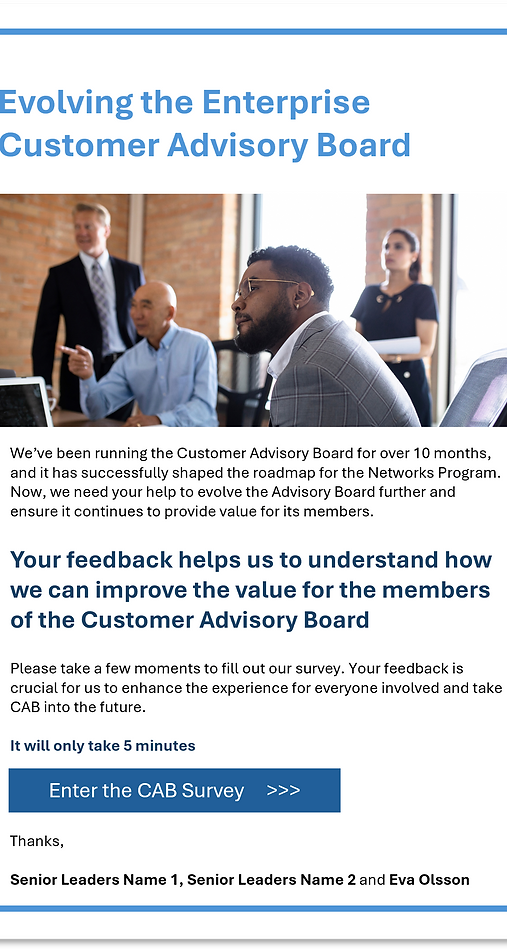
The survey was distributed via email, utilizing an HTML design that I created based on similar communications from Telstra. The image illustrated here is a mockup, not an actual representation, but it serves to demonstrate how the survey could have appeared, complete with visuals and a call to action, all in accordance with company's branding guidelines.
3. Data Analysis and Engagement Refinement
As I analyzed the survey and interview results, I didn’t just focus on the customer feedback itself but on uncovering patterns and actionable insights to sustain long-term engagement. By segmenting responses and identifying key themes, I was able to pinpoint strategies that resonated most with our customers. This process wasn’t only about data; it was also about experimenting with different approaches to keep customers actively involved. Collaborating closely with Account Managers and senior leaders, who shared their firsthand experiences, helped guide us in refining our approach. What started as a short-term concept-testing process transformed into a 10-month engagement journey—something unprecedented at this major telco.
4. Co-Creation and Customer Journey Mapping
As we progressed, it became evident that retaining customer interest over the long term was crucial. I developed customer journey maps to identify how we could create touchpoints that not only kept them engaged but also deepened their involvement in co-creation. Through trial and error, we discovered effective strategies and I documented them.
This process emphasized the importance of using the right engagement levers for this specific cohort of customers and their personas.
5. Final Report and Scalable CAB Model
By the end of the network migration program, we had more than just product feedback; we had a replicable model for engaging enterprise customers over the long term. The final report I delivered after the product insights report included lessons learned about the CAB approach and suggestions for how the company could scale the Customer Advisory Board (CAB) model across the business. This was based on our learnings from customers during the network program and the survey conducted with 680 account managers and sales professionals. What was particularly rewarding for me was that through this work, we helped transform how our major telco engaged with its most important enterprise customers, creating a process that could be sustained and scaled.
My efforts
The data from this project (as shown in the accompanying image below) indicate the effort I brought to delivering meaningful results for the team.
While confidentiality limits the details I can share, I would be happy to discuss the process and outcomes in more depth if needed.


KEY OUTCOMES OF THE CAB PROJECT
My contributions led to key outcomes, including:
Reduced Product Launch Risks: CAB feedback directly influenced product and service development, giving senior leaders the confidence to make informed decisions and reducing launch risks.
Strengthened Customer Relationships: Built deeper trust and collaboration with enterprise customers through meaningful, sustained engagement, which kept them involved long-term.
Comprehensive Customer Insights: Integrated insights from interviews and surveys provided a holistic view of customer needs, refining our approach for future CAB initiatives.
Scalable Engagement Model: Developed a templated CAB model, allowing for consistent and scalable engagement across business and enterprise segments.
Increased Customer Engagement: The scalable model led to greater customer involvement and strengthened engagement with our products and services.
Sales Growth and Value Generation: Improved customer engagement directly contributed to increased sales and added business value.
Personal Learnings
This project reinforced the importance of adaptability and collaboration for making progress. I learned how much a diverse team can accomplish through perseverance, even when things don’t go as planned. Transitioning to virtual interactions went more smoothly than I initially expected. The company’s culture of remote collaboration, combined with regular meetings and ongoing support, allowed me to build strong relationships even online. By closely collaborating with Account Managers and senior leaders, we continuously refined our approach to enhance engagement with our customers.
This experience helped me overcome initial intimidation and fueled my enthusiasm for contributing to a high-impact project. The steep learning curve around network concepts was a challenge, but with guidance from seasoned industry experts and study, I gained an understanding. I’ve found that taking the time to truly understand the business—its language, goals, and culture—is essential. It allows me to engage more effectively, follow conversations, and communicate in ways that resonate better with colleagues and stakeholders.
Disclaimer: Due to confidentiality, specific details or insights about the service or product cannot be disclosed. While my case studies focus on my contributions, I acknowledge that these achievements would not have been possible without the collaboration of my dedicated team and stakeholders. I am honored and humbled to have worked alongside such fantastic people on these projects.